Introduction
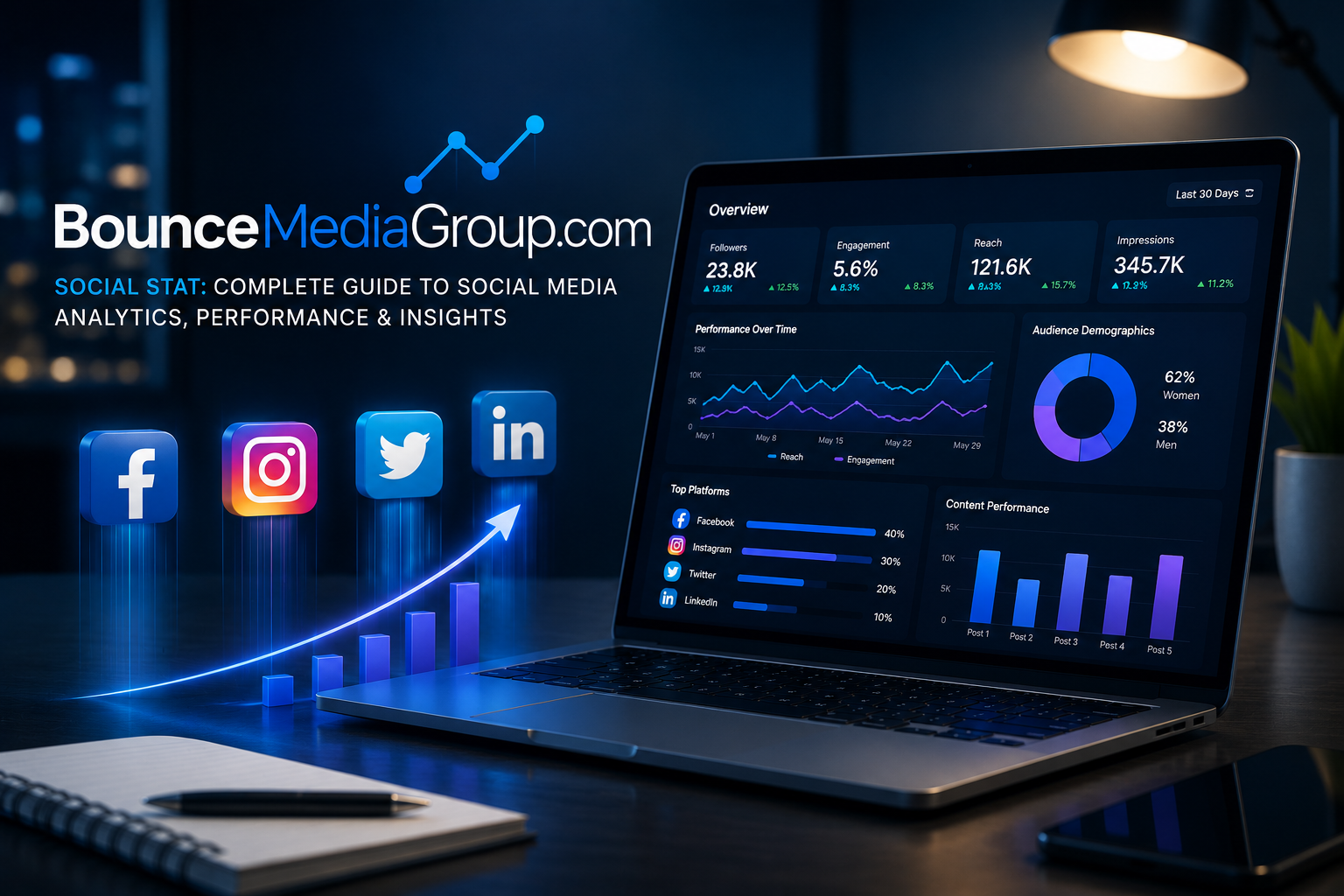
BounceMediaGroup.com Social Stat is a search term commonly associated with social media performance, audience engagement, follower growth, content reach, impressions, and other digital marketing insights connected with BounceMediaGroup.com. The website publishes content under a dedicated Social Stats category and discusses how social media data can help brands understand their audiences and improve their online strategies.
However, readers should understand that BounceMediaGroup.com Social Stat is better viewed as a collection of social media information, articles, observations, and performance discussions rather than a clearly documented standalone analytics software product. Its content explains important metrics and shows how marketers can use data to evaluate campaigns, improve content, and build stronger connections with their followers.
This complete guide explains the meaning of BounceMediaGroup.com Social Stat, the most important social media metrics, how performance is measured, and how businesses can turn social data into useful marketing decisions.
What Is BounceMediaGroup.com Social Stat?
BounceMediaGroup.com Social Stat refers to social media statistics, performance information, and digital marketing insights published or discussed in connection with BounceMediaGroup.com.
The website’s Social Stats section includes content related to follower counts, engagement, impressions, referral traffic, audience behaviour, social media trends, account security, platform features, and content-growth techniques.
In simple terms, social stats help answer questions such as:
- How many people saw a post?
- How many users interacted with it?
- Is the audience growing?
- Which type of content performs best?
- Are social media visitors reaching the website?
- Do followers take meaningful actions after viewing content?
By answering these questions, marketers can stop relying on guesses and start making decisions based on measurable results.
Why Social Media Analytics Matters
Publishing content regularly does not automatically guarantee business growth. A brand may post every day but still fail to attract the right audience or generate useful engagement.
Social media analytics helps businesses identify what is working and what should be improved. Metrics such as reach, impressions, engagement rate, clicks, and follower growth reveal whether content is connecting with users. BounceMediaGroup.com explains that analysing these measurements can help brands understand audience preferences and improve marketing decisions.
Analytics can help a business:
- Find its best-performing posts
- Understand audience interests
- Improve posting schedules
- Compare content formats
- Track brand awareness
- Measure website traffic
- Evaluate campaign results
- Spend advertising budgets more carefully
The real value of social statistics comes from using the information to improve future content.
Important Social Media Metrics to Track
Reach
Reach is the estimated number of unique users who saw a post, video, story, or advertisement.
A high reach shows that the content is being distributed to a large audience. However, reach alone does not prove that people found the content useful. It should be reviewed alongside engagement, clicks, and conversions.
Impressions
Impressions represent the total number of times content appeared on users’ screens. One person may see the same post more than once, so impressions are usually higher than reach.
Comparing impressions with reach can help marketers understand how often content is being shown repeatedly.
Engagement
Engagement includes actions such as:
- Likes
- Comments
- Shares
- Saves
- Reactions
- Link clicks
- Video interactions
Engagement is one of the most valuable indicators because it shows that users did more than simply view the content.
Engagement Rate
Engagement rate measures interactions in relation to reach, impressions, views, or followers. It provides better context than counting likes alone.
For example, 500 interactions may appear impressive, but their importance depends on the size of the audience and the number of users who saw the post.
Follower Growth
Follower growth shows whether an account is gaining or losing followers over time.
BounceMediaGroup.com discusses the importance of studying growth trends because they can reveal successful campaigns and changing audience preferences.
Marketers should focus on steady, relevant growth rather than collecting large numbers of inactive followers.
Click-Through Rate
Click-through rate measures how many people clicked a link after seeing a post or advertisement.
This metric is especially important when the goal is to send users to:
- A website
- Product page
- Registration form
- Blog post
- Online store
- Landing page
A low click-through rate may mean that the call to action, design, offer, or audience targeting needs improvement.
Referral Traffic
Referral traffic shows how many website visitors arrived through social media platforms.
BounceMediaGroup.com notes that marketers can use tools such as Google Analytics to understand traffic coming from social networks and evaluate how those visitors behave after reaching the website.
Conversions
A conversion happens when a user completes a desired action, such as:
- Buying a product
- Submitting a contact form
- Joining an email list
- Downloading a file
- Booking a service
- Creating an account
Conversions connect social media activity with actual business results.
How to Analyse Social Media Performance
Set Clear Goals
Before studying social statistics, decide what the account is trying to achieve.
Possible goals include increasing brand awareness, generating sales, attracting website visitors, collecting leads, growing a community, or improving customer support.
The correct metrics depend on the goal. Reach may be useful for awareness, while conversions are more important for a sales campaign.
Establish a Baseline
A baseline shows the account’s current performance before a new strategy begins.
Record recent averages for reach, engagement, clicks, followers, traffic, and conversions. BounceMediaGroup.com recommends reviewing existing analytics before testing new content so that marketers have a clear point of comparison.
Compare Content Types
Separate the results of:
- Images
- Short videos
- Long videos
- Stories
- Links
- Polls
- Educational posts
- Promotional content
This comparison helps identify which formats attract the strongest response from the target audience.
Review Performance Over Time
A single successful post does not prove that an entire strategy works. Review weekly, monthly, and quarterly trends to identify consistent patterns.
Long-term analysis reduces the risk of making decisions based on one unusual spike in views or engagement.
Study Audience Information
Audience data may include age groups, locations, interests, active times, devices, and platform preferences.
BounceMediaGroup.com discusses using demographic information and audience interests to refine messaging and content strategies.
Businesses should use this information responsibly and follow applicable privacy requirements.
Tools for Measuring Social Media Results
Most major social platforms provide built-in analytics for professional accounts. These tools can display reach, impressions, followers, watch time, engagement, and audience information.
Businesses can also use third-party social media management platforms to compare results across multiple channels. BounceMediaGroup.com mentions tools such as Hootsuite and Sprout Social for reviewing performance across social networks, while Google Analytics can be used to study website referral traffic.
Useful options may include:
- Native Facebook and Instagram insights
- LinkedIn analytics
- YouTube Studio
- TikTok analytics
- Google Analytics
- Social media scheduling platforms
- Website conversion tracking tools
The best option depends on the number of accounts, reporting needs, budget, and campaign goals.
How to Turn Social Stats Into Better Content
Data becomes valuable only when it leads to action.
If short videos receive better engagement than static images, produce more useful short-form videos. If educational posts generate more saves, develop a regular tutorial series. If users click frequently but do not convert, review the landing page, offer, and user experience.
Marketers should test one major change at a time. This makes it easier to understand which adjustment caused an improvement or decline.
A simple improvement process includes:
- Review the data.
- Identify a weak or strong area.
- Create a clear theory.
- Test a new approach.
- Compare the results.
- Keep, adjust, or remove the change.
Common Social Analytics Mistakes
One common mistake is focusing only on follower count. A large audience is not useful when most followers are inactive or unrelated to the brand.
Other mistakes include:
- Buying fake followers
- Ignoring comments and saves
- Comparing unrelated platforms directly
- Measuring performance without defined goals
- Changing strategies too quickly
- Treating correlation as proof of cause
- Reporting views without business outcomes
- Using statistics without checking their source
Some third-party articles publish specific figures about Bounce Media Group, but these numbers may not be independently verifiable. For accurate reporting, businesses should rely on their own platform dashboards, documented reports, and clearly dated data.
Benefits of BounceMediaGroup.com Social Stat Content
BounceMediaGroup.com Social Stat content can help beginners understand the basic language of social media measurement.
Its main benefits include:
- Simple explanations of important metrics
- Discussions about audience engagement
- Information about social media trends
- Ideas for improving content performance
- Guidance on reviewing reach and follower growth
- Coverage of platform-related topics
The website presents Social Stats as one of several categories alongside technology, industry news, travel, education, entertainment, and other subjects.
Conclusion
BounceMediaGroup.com Social Stat is associated with social media analytics, performance metrics, engagement insights, follower growth, content reach, impressions, referral traffic, and digital marketing analysis.
Rather than treating it as a confirmed standalone analytics tool, readers should understand it as a topic and content category connected with BounceMediaGroup.com. The available material explains how businesses can study social performance and make more informed content decisions.
The most effective social media strategy does not depend on likes or follower numbers alone. Businesses should connect reach, engagement, clicks, traffic, and conversions with clear marketing goals. By reviewing accurate data regularly and testing improvements carefully, brands can create stronger content, understand their audiences, and achieve more meaningful results.
Frequently Asked Questions
1. What is BounceMediaGroup.com Social Stat?
BounceMediaGroup.com Social Stat refers to social media statistics, performance information, and marketing insights associated with the website’s Social Stats content category.
2. Is BounceMediaGroup.com Social Stat an analytics software tool?
Publicly available pages mainly present it as social media content and analysis. There is not enough reliable evidence to describe it confidently as a dedicated standalone analytics software platform.
3. What metrics are included in social media analytics?
Common metrics include reach, impressions, engagement, follower growth, clicks, referral traffic, video watch time, and conversions.
4. Why is engagement rate important?
Engagement rate provides context by comparing interactions with audience size, reach, impressions, or views. It can show how strongly users respond to content.
5. What is the difference between reach and impressions?
Reach measures unique users who saw content, while impressions count the total number of times it appeared, including repeated views.
6. Can social stats improve a content strategy?
Yes. Performance data can reveal which topics, formats, posting times, and calls to action produce better audience responses.
7. How often should businesses review social media analytics?
Weekly reviews are useful for regular adjustments, while monthly and quarterly reports are better for identifying long-term trends.
8. Which tools can track social media performance?
Businesses can use native platform dashboards, Google Analytics, and established social media management tools to measure performance.
9. Is follower count the most important social metric?
No. Engagement quality, relevant traffic, leads, and conversions are often more meaningful than follower count alone.
10. How can businesses verify social media statistics?
They should check official platform dashboards, define the reporting period, document calculation methods, and avoid relying on unsupported third-party claims.